
Mysteries of the universe hidden in the depths of ice, unprecedented achievement of neutrino observatory

New York. The prestigious Nobel Prize in Physics for the year 2026 has been awarded to Professor Francis Halzen for his groundbreaking work at the IceCube Neutrino Observatory in Antarctica and the discovery of high-energy neutrinos. This honor symbolizes the unique achievement of studying the most mysterious particles of the universe and locating them in the depths of ice.
The universe’s shyest particle and the mystery of the neutrino
Neutrino is a sub-atomic particle, which is considered to be the shyest particle in the universe. It has no electric charge, no apparent mass, and no shape. It passes through any object or our body so easily that it is impossible to feel it. According to scientists, billions of neutrinos from the Sun pass through our bodies every second. These particles contain precious astronomical information related to black holes, supernova explosions and active galaxies, but capturing them was a very difficult challenge.
Unique idea to find neutrinos in Antarctica’s ice
To overcome this challenge, Professor Francis Halzen came up with a revolutionary idea in 1980 to try to capture these neutrinos in ice. He hypothesized that when neutrinos collide with transparent ice atoms, a faint glow would be produced. For this experiment, the deep, stable and extremely transparent ice of Antarctica proved to be the most ideal, where it is always dark and provides a favorable environment for scientific research.
Construction and technical characteristics of the IceCube Observatory
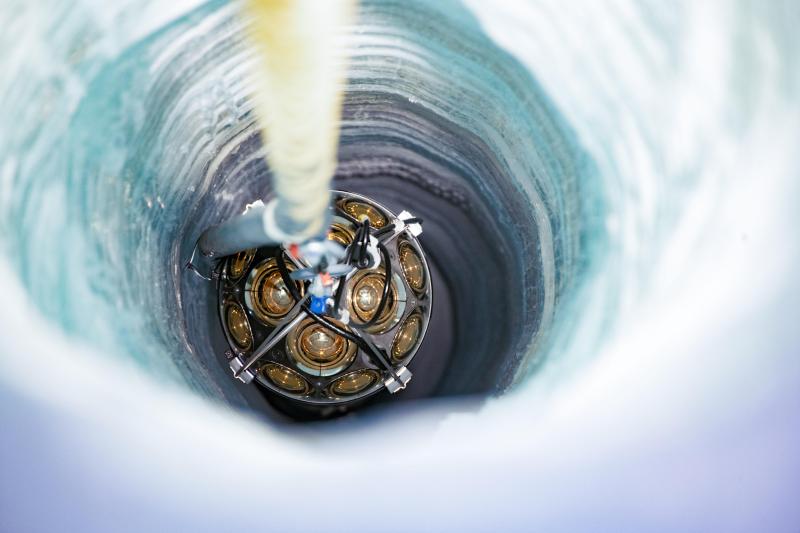
Under this project, which started in the year 1988, holes hundreds of meters deep were made in the ice with hot water and wires of sensors were inserted in them. Following the initial AMANDA detector, the giant IceCube observatory was built, which uses 1 square kilometer of ice as a detector. It has more than 5,000 sensors installed on 86 cables that capture light and convert it into electrical waves.
The beginning of a new era in astronomy
Completed in 2011, the observatory successfully detected high-energy neutrinos for the first time in 2013. This discovery has helped us understand how energy is created within the Sun and how the universe’s powerful astronomical phenomena work. Scientists are currently trying to find out where these neutrinos originally come from, opening new ways to understand the physics of the early universe.