How Buyer Education Builds Demand Before the Sales Conversation
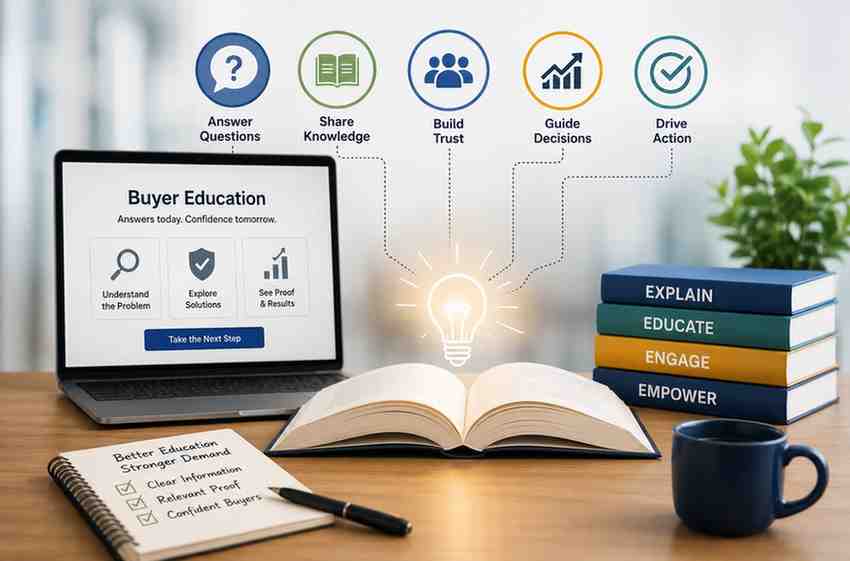
Many campaigns ask for an enquiry before the audience understands the problem, solution or reason to trust the provider. That creates resistance, especially for complex services, premium products and unfamiliar categories. Buyer education gives people context before a sales conversation.
A search-first educational hub can bring articles, FAQs and service explainers into one useful journey. Rather than attracting visitors with a broad claim and leaving them to work things out alone, the business helps them assess relevance, compare options and arrive at the next step with better questions.
Start With the Questions That Slow Decisions
The best education content starts with what prospects repeatedly ask: What does this solve? Who is it for? What changes after implementation? What proof matters? Sales calls, support teams and reviews are useful sources.
Buyer education also works in person. A conference programme designed around buyer questions gives prospects demonstrations, expert viewpoints and peer conversations, not just a stage agenda. Afterwards, training and explainer-video editing can turn the core learning into reusable assets for landing pages, sales follow-ups and social media.
Organise Content Around the Decision Journey
Do not try to answer everything in one page or video. Give each asset a role based on where the buyer is in the decision. Even a clear donation-page setup follows the same principle: people are more likely to act when needs, outcomes and participation routes are explained with care.
A practical buyer-education system includes:
- A discovery asset that names the problem in plain language.
- A proof asset that shows process, evidence or real-world use.
- A next-step asset that helps the buyer evaluate fit without pressure.
Use Credible Formats to Add Depth
Some subjects need more than a short advertisement. A founder interview gives leadership room to explain its perspective, while branded content can keep an educational message visible around relevant conversations. An ABP advertorial offers a structured, transparent setting for a longer explanation during category research.
Visual education makes complex value easier to grasp. A 3D training animation can show a process, product feature or workflow that is difficult to explain through text alone. This is useful when buyers must understand how something works before they can believe the benefit.
Adapt the Lesson for Local Markets
The core message should stay consistent, but examples, language and distribution should reflect the market. A Pune regional media plan can make education feel closer to local context. A Hindi education-and-coaching media plan and Marathi education-and-coaching campaign can carry the same idea into familiar formats and languages.
For consumer brands, learning should continue at the buying moment. An FMCG packaging checklist can help teams clarify pack information, product use and value cues before shoppers compare alternatives.
Make Education a Growth Asset
Track which questions generate visits, which pages support qualified enquiries and which explanations shorten the sales cycle. Over time, the strongest answers become a reusable library that builds trust before the first call and improves later conversations.